






All Mocha Apps
Back to Mocha Technologies
All Mocha apps

 Business OperationsManage day-to-day operations
 Property AccountingComplete property accounting
 Lease ManagementManage leases efficiently
- Pricing
All Mocha apps
Business OperationsManage day-to-day operationsProperty AccountingComplete property accountingLease ManagementManage leases efficiently
Key Takeaways
A lease renewal is the agreement, signed before the current term ends, that keeps a good tenant in the unit on a new fixed term or on a month-to-month basis. Done well, it is the cheapest lease you will sign all year: no vacancy, no turnover work and no marketing. Done late, it quietly becomes a month-to-month tenancy, a surprise move-out or a rent dispute.
This guide is written for landlords, small multifamily owners and property managers. It covers when to start the lease renewal process, what a renewal letter should say (with a template), how month-to-month conversions work, and how to handle rent changes at renewal, including notice rules and rent caps. It is general information, not legal advice. Notice periods and rent rules differ by state and sometimes by city.
Free download: Lease Renewal Tracker and Rent Change Calculator (Excel). Track each lease's end date, the date to send the renewal letter, the response deadline and the status. Enter current rent and a proposed increase to see the new rent, the annual change, a rent-cap check and a renew-versus-re-lease comparison. Download the free Lease Renewal Tracker and Rent Change Calculator
Keeping a tenant is usually cheaper than replacing one, and recent data shows renters are staying put.
| Data point | Figure | Source and date |
|---|---|---|
| Tenants who renewed, industrywide | About 65% to 70% | CRE Daily, citing Piper Sandler, Q1 2025 |
| Apartment REIT retention | Above roughly 60%, versus the low 50s a decade ago | GlobeSt, citing CoStar's Grant Montgomery, April 2026 |
| Average residential turnover cost | Nearly $4,000 per unit | Zego 2023 report, as cited by The Guarantors, August 2024 |
| Saving per apartment from avoided turnover | $750 to $1,800 | CRE Daily, 2025 |
| Renewal likelihood by friends in the building | 29% (none), 38% (one to three), 47% (seven or more) | RealPage study, as cited by The Guarantors |
| Residents in pet-friendly buildings | Stay 21% longer | Michaelson Found Animals study, as cited by The Guarantors |
Two cautions. First, turnover cost depends on your unit, your market and what you count, so treat the dollar figures as ranges and replace them with your own numbers. Second, high retention is not always a sign of happy tenants. CoStar's analyst notes that retention is driven as much by cost and friction as by satisfaction, and that some renters now pay more to renew than they would pay by moving. A renewal strategy built on that assumption can backfire when the market loosens.
The practical conclusion: the renewal conversation is worth starting early, pricing carefully and documenting well.
Most guides agree on the window. Avail recommends offering the renewal about 90 days before expiry and asking for a reply within 30 days, which leaves at least 60 days to re-lease if the tenant declines. TurboTenant says renewal talks typically start two to three months out, depending on local law. Use the schedule below as a working default, and shorten or lengthen it to match your state's notice rules.
| When (days before lease end) | Action | Why it matters |
|---|---|---|
| 120 to 100 | Review the lease, payment history, maintenance requests and market rent. Decide: renew, renew with changes, convert to month-to-month, or do not renew. | Some states require non-renewal or rent-increase notice 60 to 90 days out, so the decision has to come first. |
| 90 | Send the renewal offer, with the new rent and term options. Send any legally required rent increase notice at the same time or earlier. | Gives the tenant time to compare options and you time to re-lease. |
| 75 | Follow up by phone or text and log the conversation. | Non-responses are often oversight, not a decline. |
| 60 | Response deadline. No answer is treated as a decline for planning purposes, but check what your lease and state law say before acting on it. | Protects your lease-up window. |
| 60 to 45 | If the tenant declines or goes silent, send any required non-renewal notice, schedule the move-out inspection and begin marketing. | Marketing a unit while it is still occupied can shorten vacancy. |
| 30 | Renewal signed, or the unit is listed and shown. | A signed renewal now avoids an accidental month-to-month tenancy. |
| Lease end | New term begins, or move-out inspection and key return. | Keep the file complete either way. |
Setting the dates in a tracker, rather than in memory, is the single biggest improvement for a portfolio of more than a handful of units. The download includes the schedule as formulas: enter the lease end date and it returns the send date, reminder date and response deadline for each unit.
A renewal letter is a written offer. It should be specific enough that the tenant can say yes without a follow-up question. Avail's sample letter and TurboTenant's checklist both include the same core items.
If you are raising rent, check your state's rules on whether a separate rent increase notice is required and how far ahead it must be sent. Our guide to rent increase notices covers the state-by-state timing.
[Date]
Dear [Tenant name(s)],
Your lease for [address, unit] ends on [lease end date]. We have enjoyed having you as a resident and would like you to stay.
Your renewal options:
Changes to your lease: [list any changes to fees, policies or terms, or write "None"].
To accept, please sign and return the enclosed renewal agreement by [deadline] or [online method]. If we do not hear from you by then, [describe what happens, consistent with your lease and state law].
Please call or email [contact] with any questions.
Sincerely,
[Name, title, company]
Have an attorney or your state landlord association review the wording before you use it as your standard template.
A month-to-month tenancy has no end date. It renews each month until the landlord or tenant gives proper written notice. It happens in two ways:
When it makes sense: the tenant needs short-term flexibility, you plan to sell or renovate, you are still deciding on the next term, or you want to adjust rent more often in a fast-moving market. TurboTenant also lists month-to-month as a way to raise rent in high-demand markets, as long as the notice rules are followed.
The trade-off: you lose predictability. TenantCloud's 2026 guide warns that a premium of $100 to $200 a month may not cover even a few weeks of vacancy. A $150 premium brings in $1,800 over a year, which is about the cost of one vacant month on a $1,600 unit once turnover work is added.
These figures come from Nolo's state chart and the Nomad Lease summary, and sources disagree in places. Many states also add just-cause or local rules that override the general period. Use the table to see how much the answer varies, not as a substitute for your state statute.
| State | Landlord notice to end (no cause) | Notice to change rent | Notes |
|---|---|---|---|
| California | 30 days if the tenancy is under 12 months; 60 days after (Nomad Lease) | 30 to 90 days, depending on the increase | Statewide just-cause rules apply to many units after 12 months |
| Colorado | 21 days (1 to 6 months), 28 days (6 to 12 months), 91 days (1 year or more) under the general statute | No statewide rent-increase notice period found; 21 days is commonly cited for month-to-month | Since April 2024 most residential landlords need cause, or 90 days' notice for a no-fault ending; verify |
| Florida | 30 days (Nolo) | 30 days | Some older sources still list 15 days |
| Georgia | 60 days (tenant gives 30) | 60 days | |
| Illinois | 30 days statewide | 30 days | Some cities set longer periods, such as Chicago |
| Maryland | 60 days (Nolo); one other source lists 30 | 90 days per Nolo | Verify before use |
| New York | 30 to 90 days, by length of tenancy | 30, 60 or 90 days for increases of 5% or more | Good Cause rules can apply |
| Oregon | 30 days in the first year; after that, for-cause notices only | 90 days after the first year; none in the first year | |
| Texas | One month | One month | |
| Washington | Just cause required | 60 days (30 if subsidized) | Tenant gives 20 days |
The lesson for renewal planning: if your state requires 60 or 90 days' notice for a rent change or non-renewal, your renewal offer cannot wait until 45 days before the lease ends.
The renewal is the one moment a rent change is expected, but it is also the moment tenants compare your price with the market. Three checks keep the number defensible.
1. Market check. Compare your current rent and the proposed rent with similar available units nearby. A renewal priced far above the market invites a move-out.
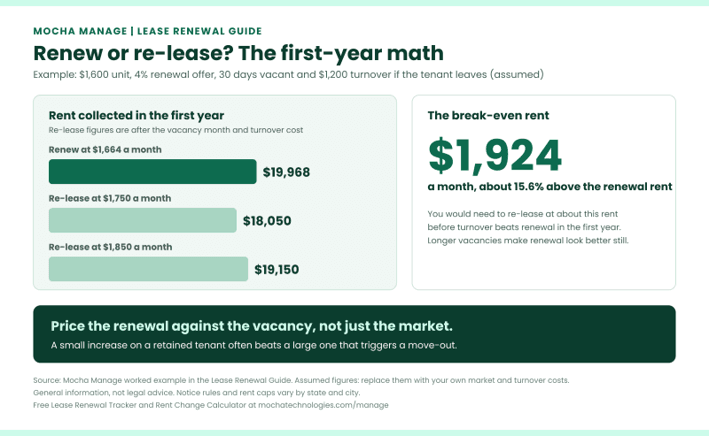
2. Cost-of-vacancy check. The tenant's alternative to paying your increase is leaving, and you then bear vacancy and turnover costs. The worked example below shows where the break-even sits.
3. Legal check. Confirm the notice period for the increase, any limit on how much or how often rent can rise, and whether the increase is allowed during a fixed term.
A unit rents for $1,600 a month. You offer a renewal at 4%.
The illustration uses assumed numbers and ignores concessions, longer vacancy and later years. Longer vacancies make renewal look better still. Add your own figures to the download to test your units.
Most states do not cap rent increases on private rentals, but a growing number do. TurboTenant's August 2026 summary of state caps reports:
| State | 2026 limit | Formula | Resets |
|---|---|---|---|
| Washington | 9.683% | Lesser of 10% or 7% plus CPI (House Bill 1217) | January 1 |
| Oregon | 9.5% for most rentals | Lesser of 10% or 7% plus CPI | January 1 |
| California | About 8.1% to 8.8% by region | Lesser of 10% or 5% plus regional CPI (AB 1482) | August 1 |
| New York | About 8.15% to 8.38% (presumptive standard, not a hard cap) | Lesser of 10% or 5% plus CPI; an increase above it is presumed unreasonable, not banned | August 1 |
Local rent control, exemptions and just-cause rules add complexity, and Washington's cap also bars increases in the first 12 months of a tenancy. For a $1,600 rent, a 9.683% cap would allow up to about $1,755 a month, but the lawful maximum depends on the place and the date the notice is given.
Renewals go wrong when dates live in a spreadsheet nobody opens. Mocha Manage is property management software for landlords and property managers, built to keep leases, tenant records, rent and communication in one place. That can give your team one place to track which leases end soon and what has been sent. Book a demo of Mocha Manage to see how it fits your portfolio.
This article is for general information and is not legal advice. Notice periods, rent caps and just-cause rules vary by state and city and change often. Have an attorney review your renewal letter, notices and lease before you use them.
How far in advance should I send a lease renewal offer? Many landlords send it about 90 days before the lease ends, and ask for a reply within 30 days (Avail). TurboTenant says discussions typically start two to three months out. If your state requires notice of a rent increase or non-renewal, that period sets the latest date.
Do I have to offer a tenant a lease renewal? In many states, no, but some states and cities require just cause or give tenants renewal protections, including California, New York, Oregon and Washington. Check your rules before declining to renew.
What is the difference between a lease renewal and a lease extension? A renewal is usually a new lease, often with updated rent and terms. An extension keeps the existing lease and adds time on the same terms, typically through a short signed addendum.
Can I raise the rent at lease renewal? Generally yes, with the notice your state requires, and subject to any rent cap. Rent normally cannot change during a fixed term unless the lease allows it.
What happens if the lease ends and nobody signs a renewal? In many states the tenancy continues month to month, but some leases and laws treat it differently. Confirm the rule in your lease and state, then document the tenant's status in writing.
Should I convert a tenant to month-to-month instead of a lease renewal? Month-to-month gives flexibility and lets you adjust rent with notice, but it raises vacancy and turnover risk. It suits tenants with short-term needs or units you plan to sell or renovate, not most long-term residents.
Sources differ on several state notice periods (Florida, Illinois, Maryland and Colorado in particular). Turnover-cost and retention figures are third-party estimates and may not match your market.
Disclosure: Mocha Manage publishes this blog. This guide is for informational purposes only and does not constitute legal advice. Consult a professional familiar with landlord-tenant law for advice specific to your situation.