



All Mocha Apps

 Business OperationsManage day-to-day operations
 Property AccountingComplete property accounting
 Lease ManagementManage leases efficiently
- Pricing
Business OperationsManage day-to-day operationsProperty AccountingComplete property accountingLease ManagementManage leases efficiently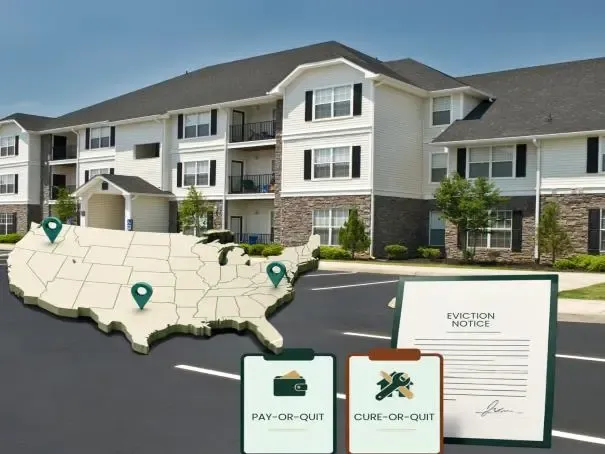
An eviction notice is the formal written warning a landlord must serve before filing in court, and a notice that is wrong in timing, wording or delivery can force you to start over. Most evictions that go sideways do so at this first step, not in the courtroom.
This guide is written for independent landlords, residential property managers and multifamily property managers who want to know how to evict a tenant the right way. It explains the eviction process from start to finish: the main notice types, the usual sequence from notice to court, and the documentation that keeps your case clean. It is general information, not legal advice. Notice periods, required wording and local rules vary by state and sometimes by city, so confirm the current rules with your state statute or a landlord-tenant attorney before you serve anything.
Free Download: Eviction Notice Timeline Tracker (Excel). Log each notice, pick the state, and the sheet works out the date the cure period ends and flags notices that need a decision. It includes a state-by-state nonpayment reference. Download link
Courts generally expect the landlord to follow the notice rules exactly. If a tenant's attorney can show you used the wrong form, gave too few days, or served the notice improperly, the judge may dismiss the case. You then lose weeks of time, keep carrying the unit's costs, and still have an unpaid tenant.
The name of the notice changes from state to state. A pay or quit notice may be called a notice to quit, a demand for rent or a notice to vacate, but most fall into a few groups.
For unpaid rent, the response window is often as short as three days or as long as 14 or more. The examples below are common published figures for nonpayment and are for illustration only. Always confirm the current period and how days are counted.
| State | Typical nonpayment notice | Note |
|---|---|---|
| California | 3 days | Excludes weekends and court holidays; must state the exact amount due |
| Texas | 3 days | A lease can set a different period |
| Florida | 3 days | Weekends and holidays are generally excluded |
| Illinois | 5 days | Some cities set longer periods |
| New York | 14 days | Additional rules apply in some cities |
| Washington | 14 days | State and local protections may add steps |
Using a three-day notice where the law requires 14 can get the case dismissed, so the number matters.
The six-state table above shows how far apart the rules can be. This table groups more states by the length of the nonpayment notice. Sources disagree on a few states, so treat it as a starting point and confirm in your state's statute before you serve anything.
| Notice period | States | Things to know |
|---|---|---|
| No fixed waiting period | Georgia, West Virginia | Landlord may demand rent and file; local practice and court rules still apply |
| 3 days | Arkansas, California, Florida, Idaho, Iowa, Texas, Utah, Wyoming | California and Florida exclude weekends and legal holidays; a Texas lease may set a longer period |
| 5 days | Arizona, Delaware, Hawaii, Illinois, Rhode Island, South Carolina, Virginia | Hawaii counts business days; Chicago has its own ordinance; Virginia is 14 days in federally assisted housing |
| 7 days | Alabama, Alaska | |
| 10 days | Indiana, Pennsylvania | |
| 14 days | Massachusetts, Minnesota, New York, Tennessee, Vermont, Washington | Some NYC situations run longer |
| 30 days | District of Columbia | Sources cite 30 days for DC, but DC rules are unusual, so confirm with counsel. New Jersey is left out because sources disagree |
In short, more than a third of states sit at 3 days, and a smaller group sits at 10 to 14 days. If you manage across state lines, a single national template is the wrong tool. Build one template per state and let your software choose it.
The steps look similar across the country, even though the details differ.
1. Confirm the facts. Check the lease, the tenant's ledger and any payments received. Make sure the amount you claim is accurate and that late fees are allowed by your lease and state law.
2. Choose the right notice. Match the notice type to the problem: unpaid rent, curable violation, serious violation or lease end.
3. Serve it correctly. Use a delivery method your state allows, such as personal delivery, posting plus mailing, or certified mail, and record exactly how and when you did it.
4. Wait out the full period. Count days the way your state does. Some states skip weekends and holidays, and some add days for mailing.
5. Handle payments carefully. Decide in advance how you will treat a partial payment after notice. In some states, accepting one can weaken your case, so follow your attorney's guidance and apply the same policy to every tenant.
6. File in court if the problem remains. Eviction is a court process. After a hearing and a judgment for the landlord, a sheriff or marshal carries out the removal.
Never try to force a tenant out yourself by changing locks, removing belongings or shutting off utilities. Self-help evictions are generally illegal and can expose you to damages. Check for local pauses, required mediation, and just-cause or relocation rules before filing.
Multifamily property managers serve more notices across more units, so consistency is the main risk. A few habits help.
A clean paper trail is your best protection. Before you serve a notice, make sure you can show the court the following.
Consistency matters as much as paperwork. Apply the same late-fee, grace-period and notice practices to every tenant. Uneven treatment can look like discrimination, and fair housing claims often surface in eviction cases. Do not time a notice as a reaction to a repair request, complaint or other protected activity, because retaliation defenses are common.
If a tenant reports a disability or asks for an accommodation, respond before moving forward, and ask your attorney how it affects the case.
Courts look at the notice first. These are the errors that cost landlords the most time:
Say a landlord hand-delivers a nonpayment notice on Friday, November 6. The end date depends on how the state counts. These dates are illustrative and use November 2026.
| Counting rule | Count | Cure period ends |
|---|---|---|
| 3 calendar days, all days count | Sat 7, Sun 8, Mon 9 | Monday, November 9 |
| 3 days, weekends and court holidays excluded | Mon 9, Tue 10, Thu 12 (Wed 11 is Veterans Day) | Thursday, November 12 |
| 5 calendar days | Sat 7 through Wed 11 | Wednesday, November 11 |
The same notice served on the same day ends on three different dates. That is why the tracker below asks for the state, the service date and any extra days, and calculates the end date for you.
Most eviction problems trace back to scattered records. Mocha Manage keeps the lease, the tenant ledger and payment history, tenant communications and documents together, so you can pull a clear timeline when you need one. Online payments, AutoPay and automated late fees help keep charges consistent and visible, and a complete ledger makes it easier to prepare an accurate notice.
Book a demo of Mocha Manage to see how property managers and landlords track leases, payments and tenant communication from one platform.
The free tracker is an Excel workbook with four tabs, built so a small landlord or a property team can use it the same day:
Download the Eviction Notice Timeline Tracker (.xlsx)
Want the same record kept automatically, with the notice, the payment history and the reminders in one place? That is what the Mocha Manage section above describes.
How do I evict a tenant? Serve the correct written notice for your state, wait out the full period, and file in court if the problem remains. Only a court order allows removal, and only the sheriff or marshal carries it out.
What is a notice to quit? In some states, it is the written notice that tells a tenant to leave by a set date. Other states use different names for the same step, so use the name and wording your state requires.
How long is a pay or quit notice? For unpaid rent it is commonly three to 14 days, depending on the state and sometimes the city. Confirm how your state counts days.
Can a tenant stop the eviction by paying? In many states, paying everything owed within the pay or quit period ends the notice. A few states do not allow it, so check your state's rule.
Can I take a partial rent payment after serving a notice? It depends on the state. In some states, accepting rent after the notice is served can weaken or restart the case. Ask your attorney for the rule in your state, put your policy in writing, and use a written receipt that says what the payment covers.
Can I change the locks or remove the tenant's belongings? No. Self-help eviction is illegal in all 50 states. Only a court order carried out by the sheriff or marshal can remove a tenant, and a landlord who locks a tenant out can owe damages.
This article is for general information and is not legal advice.
Search results reviewed Nov 11, 2026. Verify current rules against your state statute before relying on any figure.
Added in the 2027 revision (search results reviewed November 11, 2026):
- iProperty Management: eviction notice by state, state notice table
- LegalTemplates: eviction notice, distribution of 3-, 5-, 7-, 10- and 14-day states
Sources disagree on a handful of states (for example Kansas, Colorado, South Dakota and New Jersey), so those states are left out of the table or flagged. Verify each period against your state statute.