Property Management Software
8 Common Property Management Accounting Mistakes (and How to Avoid Them)
Mocha Manage•November 3, 2026
Most property management accounting mistakes aren't dramatic. They're slow leaks.
A deposit booked as income here. A reconciliation skipped there. An expense coded to the wrong property. Individually, none of them looks like a crisis. But they compound, and in an industry where margins are already tight, a handful of small accounting errors can quietly become a six-figure problem, or a lawsuit.
The good news is that these mistakes are well known and avoidable. Property management accounting has a fiduciary dimension most businesses never face: you're handling money that legally belongs to other people (tenants, owners), which raises the stakes and narrows the margin for error.
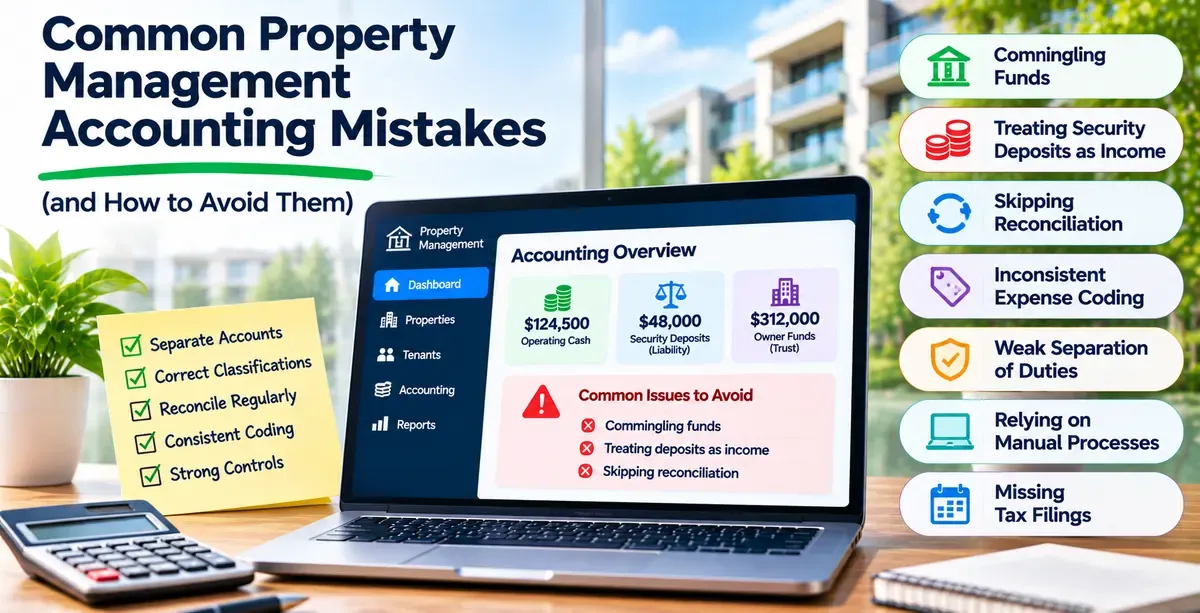
The eight mistakes below fall into a few groups. Some are about how you handle other people's money (commingling funds and misclassifying deposits), where the risk is legal and licensing exposure. Others are about the discipline of good bookkeeping (skipping reconciliation, inconsistent coding, and cash-versus-accrual confusion), where the damage is unreliable reports and bad decisions.
The rest are about your systems and controls (weak separation of duties, manual data entry, and missed tax filings), where the root cause is usually a process trying to do a system's job. Each mistake below comes with a specific fix.
This is the most common and most dangerous mistake in property management accounting.
Commingling happens when tenant security deposits, owner reserve funds, or rental income get mixed into your operating account. The result is financial chaos and real legal risk. Most U.S. states require property managers to keep client funds in separate trust accounts, and violating that isn't just sloppy bookkeeping, it's often a licensing issue.
Keep separate accounts for operating funds and trust funds (security deposits, owner money). Never let deposits or owner funds flow through your operating account. Reconcile the trust account monthly against the sum of individual owner and tenant balances. This is the foundation of trust accounting, and it's non-negotiable.
Closely related to commingling, this is the mistake of recording a security deposit as revenue when you receive it.
A security deposit isn't income. It's a liability, money you owe back to the tenant until the lease ends and you have a lawful reason to keep some of it. Booking it as income inflates your reported earnings, distorts owner distribution reports, and can trigger legal and tax problems.
Record every deposit as a liability, not income, and hold it in a separate account. We cover the full process in our guide to security deposit accounting, but the short version is: deposits go on the balance sheet as a liability, never on the income statement.
Reconciliation, matching your books against your bank statements, is where errors get caught. Skip it, and errors hide and compound.
When reconciliation is delayed or done sporadically, discrepancies pile up. By the time you look, a transposed number or a payment applied to the wrong property is buried under months of activity, and untangling it becomes a project.
Reconcile monthly, on the same day each month. Regular bank reconciliation in small chunks catches problems while they're still small and easy to fix. Software that connects to your bank and matches transactions automatically makes this a few-minute task instead of a dreaded chore.
This is the most frequent day-to-day error, and the most quietly damaging.
When the same type of expense gets coded to different accounts or the wrong property, your property-level reporting slowly becomes unreliable. Owner statements come out wrong, or require manual correction every month, and the numbers you use to make decisions stop reflecting reality.
Use a consistent, well-structured chart of accounts and code every transaction the same way every time. Consistency is what makes property-level reports trustworthy. Standardized categories reduce the guesswork that leads to miscoding.
Many property managers don't clearly choose (or understand) their accounting method, which leads to inconsistent books.
Cash-basis accounting records income when money arrives and expenses when they're paid. Accrual-basis records income when it's earned and expenses when they're incurred. Keep in mind, mixing the two, or not knowing which you're using, produces financials that don't hold together. Commercial portfolios in particular often need accrual accounting to reflect lease obligations accurately.
Pick the method that fits your business (cash for simpler residential, accrual for commercial or when lenders require it) and apply it consistently. If you're unsure, a CPA can help you choose. What matters is consistency once you've chosen.
When one person collects rent, records transactions, and reconciles the accounts, you've created an environment where errors and fraud can go undetected.
This isn't about distrusting your team. Separation of duties is a control that protects everyone, including honest employees, from mistakes and false accusations. Property management is especially vulnerable because of the volume of cash and trust funds involved.
Where possible, separate the duties so different people collect money, record transactions, and reconcile accounts. Use software with user permissions and audit trails. Review bank and credit card statements personally rather than delegating every check. Even small operations can build in some oversight.
Many of the errors above share a root cause: manual processes and systems that don't talk to each other.
Spreadsheets work for five properties. They break at fifty. Manual data entry, copy-pasted reports, and disconnected tools create the exact conditions where mistakes hide: transposed numbers, payments on the wrong property, duplicate vendor payments. More properties mean more transactions and more places for errors to creep in.
Centralize accounting, rent collection, and expense tracking in one connected system. When your data lives in one place, you start each month with clean, complete records instead of spending the first week assembling them from scattered sources.
Failing to track vendor payments properly means you can't file required tax forms, which exposes you to penalties.
The IRS requires 1099 forms for most vendors you pay $600 or more in a year. Without clean vendor records (legal name, tax ID, W-9 on file), you can't file correctly, and duplicate or missing vendor records make the problem worse.
Maintain one master record per vendor with their W-9 and tax ID, and review the vendor list periodically to merge duplicates. Software that tracks payments by vendor makes 1099 filing straightforward at year-end instead of a scramble.
Look back over these mistakes and a pattern emerges. Commingling, misclassified deposits, skipped reconciliation, inconsistent coding: nearly all of them trace back to either a weak accounting foundation or manual processes trying to do a system's job.
That's why the tool you use matters so much. Property management software built on real, correct accounting prevents many of these mistakes by design, rather than leaving you to catch them by hand.
Mocha Manage was built by CPAs specifically because property management accounting is unforgiving. Trust funds stay separated from operating funds. Deposits record as liabilities automatically. Bank feeds make reconciliation quick. A consistent chart of accounts keeps coding clean. And vendor tracking keeps 1099s manageable. The mistakes that come from manual processes and disconnected systems largely disappear when the accounting is correct from the ground up.
You don't have to be an accountant to keep clean books. You just need a system that was built by people who are.
Try Mocha Manage free to see how CPA-built accounting prevents these mistakes by design.
What is the most common property management accounting mistake?
Commingling, mixing tenant deposits or owner funds with your operating account, is the most common and most serious. In most states it's a licensing violation, not just an accounting error, and it can trigger significant penalties.
Why can't I treat security deposits as income?
Because a deposit belongs to the tenant until the lease ends and you have a lawful reason to keep part of it. It's a liability, not income. Recording it as revenue inflates your earnings, distorts owner reports, and creates legal and tax exposure.
How often should I reconcile my accounts?
Monthly, ideally on the same day each month. Regular reconciliation catches errors while they're small. Delaying it lets discrepancies pile up and get buried, turning a quick fix into a time-consuming project.
What's the difference between cash and accrual accounting?
Cash-basis records income and expenses when money changes hands. Accrual-basis records them when earned or incurred. Cash is simpler and common for residential; accrual gives a more accurate picture for commercial portfolios and is often required by lenders.
How does software help prevent accounting mistakes?
Software built on real accounting keeps trust and operating funds separate, records deposits as liabilities automatically, connects to your bank for fast reconciliation, enforces consistent expense coding, and tracks vendors for 1099s, preventing many common errors by design.
Do I need an accountant if I use property management software?
Software handles the day-to-day correctly, but a CPA is still valuable for tax strategy, choosing your accounting method, and complex situations. The best setup pairs accounting-first software with professional advice when you need it.
Disclosure: Mocha Manage publishes this blog. This guide is for informational purposes only and does not constitute legal, financial, or accounting advice. Consult a qualified accountant or attorney for advice specific to your situation.