Payroll Processing in India: A Step-by-Step Guide for Employers
Mocha HRMS|Oct 07, 2026|4 min read
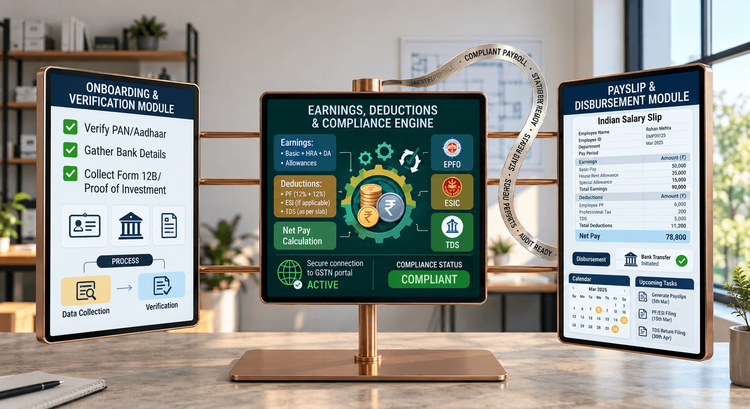
Payroll is more than paying salaries. Every month, employers in India have to calculate pay for each employee, account for attendance and leave, deduct PF, ESI, professional tax and TDS, pay employees on time, deposit statutory dues and file returns, all against fixed deadlines.
Get it right and nobody notices. Get it wrong and you face unhappy employees, interest and penalties from authorities and hours of rework.
This guide walks through payroll processing in India step by step, from setting up the basics to paying employees and staying compliant, with a worked example and a compliance calendar you can follow every month.
A smooth payroll run depends on getting the groundwork right. Before processing salaries for the first time, make sure you have the following in place.
Statutory registrations: Depending on your size and location, you may need:
Salary structures: Define how each employee's CTC is split into components such as basic pay, HRA, allowances, and employer contributions.
Payroll policies: Document your pay cycle, pay date, attendance cut-off date, leave rules, overtime, reimbursements, and bonus policy.
Employee data: Collect each employee's PAN, Aadhaar, UAN, ESI number (if applicable), bank account details, tax regime choice and investment declarations.
Let's take an employee in Maharashtra with a monthly gross salary of ₹40,000, who took 2 days of leave without pay in a 30-day month.
| Component | Full month | For 28 paid days |
|---|---|---|
| Basic pay | ₹20,000 | ₹18,666.67 |
| HRA | ₹8,000 | ₹7,466.67 |
| Special allowance | ₹12,000 | ₹11,200.00 |
| Gross salary | ₹40,000 | ₹37,333.33 |
| Employee PF (12% of basic, on the ₹15,000 wage ceiling) | − ₹1,800.00 | |
| ESI (not applicable, as gross exceeds ₹21,000) | ₹0 | |
| Professional tax (Maharashtra) | − ₹200.00 | |
| TDS (no tax due under the new regime at this income) | ₹0 | |
| Net pay | ₹35,333.33 |
On top of the employee's salary, the employer also contributes ₹1,800 towards PF. This is part of the employee's CTC, but not their take-home pay.
Some employers calculate PF on the full basic pay instead of the ₹15,000 ceiling. Both are allowed, but the choice must be applied consistently.
Missing a deadline means interest, late fees or penalties. These are the key dates most employers need to track.
| Due date | What's due |
|---|---|
| By the 7th of each month | Salary payment for the previous month, for monthly-paid employees under the Code on Wages |
| 7th of each month | TDS on salaries deposited for the previous month (30 April for March) |
| 15th of each month | PF contributions and ECR filing for the previous month |
| 15th of each month | ESI contributions for the previous month |
| As per state rules | Professional tax payment and returns (monthly, quarterly, or annually depending on the state) |
| As per state rules | Labour Welfare Fund contributions (usually half-yearly or annually) |
| 31 July, 31 October, 31 January, 31 May | Quarterly TDS return on salaries |
| 15 June | Form 16 issued to employees for the previous financial year |
Due dates can be extended by the authorities and state rules vary, so keep a calendar that's reviewed and updated regularly.
Payroll in India is shaped by a mix of central and state laws.
The four labour codes: The Code on Wages, the Code on Social Security, the Industrial Relations Code and the Occupational Safety, Health and Working Conditions Code came into effect in November 2025. They replace 29 older labour laws, including the Payment of Wages Act, the Minimum Wages Act, the EPF Act, the ESI Act and the Payment of Gratuity Act. State rules under the codes are still being rolled out, so some older procedures continue in the meantime.
The 50% wages rule: Under the Code on Wages, if allowances (excluding certain items like HRA and conveyance) exceed 50% of total pay, the excess is added back to "wages". This affects PF, gratuity, and other calculations, and has pushed many employers to raise basic pay.
Income tax: Employers must deduct TDS on salaries and issue Form 16. From 1 April 2026, the Income-tax Act, 2025 replaced the Income-tax Act, 1961. Section numbers and some form names have changed, but the core process of deducting tax from salary works the same way.
State laws: Professional tax, Labour Welfare Fund and Shops and Establishments Acts vary by state and set rules for working hours, holidays and leave.
Because these laws are changing, check the latest rules with your CA or labour law consultant.
Mocha HRMS brings attendance, leave and payroll together, so salaries are calculated from accurate data without manual copying between systems.
With Mocha HRMS, payroll becomes a routine monthly task instead of a week-long scramble.
Payroll in India follows a clear monthly rhythm: collect inputs, calculate pay and deductions, pay employees, deposit statutory dues and file returns. The rules are detailed, but with good processes and the right tools, they're entirely manageable.
Ready to run payroll in minutes, not days? Book a free demo of Mocha HRMS and see how easy compliant payroll can be.
Most businesses run payroll monthly. Weekly or fortnightly cycles are common for daily-wage and contract workers.
PF is mandatory for establishments with 20 or more employees, for employees earning up to ₹15,000 a month in PF wages. Employees earning more can join voluntarily.
CTC is the total cost to the company, including employer contributions. Gross salary is what the employee earns before deductions. Net pay is what they take home after deductions.
Only when the employee's estimated taxable income for the year exceeds the tax-free limit under their chosen regime.
Small teams often start with an accountant or outsourced provider. As you grow, payroll software gives you more control, fewer errors and faster processing at a lower cost.