








All Mocha Apps
Back to Mocha Technologies
All Mocha apps

 Business OperationsManage day-to-day operations
 Property AccountingComplete property accounting
 Lease ManagementManage leases efficiently
- Pricing
All Mocha apps
Business OperationsManage day-to-day operationsProperty AccountingComplete property accountingLease ManagementManage leases efficiently
Key Takeaways
Make coverage a lease condition, not an afterthought.
Self storage insurance protects two different things: the operator's business, and the goods tenants keep in the units. Operators control the second through their lease, usually by requiring a tenant to carry coverage and by offering a tenant protection plan or tenant insurance program to those who do not. Getting it right reduces disputes after a theft, fire or roof leak, and it can add a meaningful revenue line.
This guide is written for self storage owners and facility managers. It explains the difference between tenant insurance and a tenant protection plan, what operators should require in the rental agreement and at move-in, how licensing and regulation affect what you can sell, how to track compliance, and what the economics look like. It is general information, not legal or insurance advice. Rules differ by state, and the right structure depends on your state and your insurance advisor.
Free download: Self Storage Tenant Insurance Compliance Tracker and Revenue Calculator (Excel). Track each tenant's coverage status, proof date and expiry, flag who is out of compliance, and model program revenue by attach rate, premium and share kept. Download the free Tenant Insurance Compliance Tracker and Revenue Calculator
| Data point | Figure | Source and date |
|---|---|---|
| Households renting a storage unit | More than 11% of U.S. households | Stora, February 2026 |
| National vacancy forecast | About 10% at year-end 2026, helped by stronger retention | Marcus & Millichap, September 2026 |
| Average asking rent | Forecast to fall 0.8% in 2026 to about $1.18 per square foot | Marcus & Millichap, September 2026 |
| New supply | Smallest delivery slate since 2016 (2.2% of inventory) | Marcus & Millichap, September 2026 |
| Typical ancillary income, including tenant insurance | 3% to 5% of gross income, up to 20% at some managers | Modern Storage Media, 2016 |
| Participation when coverage is a lease requirement | 55% to 80% at move-in, versus 5% to 30% when optional | Inside Self-Storage, 2017 |
With rents flat to down, ancillary income matters more than it did when rates were rising. But the participation figures above are nearly a decade old, and vendor case studies are self-reported, so use them as direction, not as a forecast for your facility. For example, Storable reports that one 29-property operator reached 87% insurance penetration and more than $20 a month per enrolled tenant (up from $9) with minimum coverage tiers, automatic enrollment with opt-out and an audit letter program. That is a vendor case study, not an independent benchmark.
Risk matters as much as revenue. Operators are often not liable for tenants' goods when the lease says so, but disputes after a loss are expensive and bad for reviews. Inside Self-Storage notes that having no insurance program is not a defense to a lawsuit. A clear requirement, documented at move-in, is the simplest protection.
Operators often use these terms interchangeably, but they are different products with different legal treatment.
| Tenant's own policy | Tenant insurance | Tenant protection plan | |
|---|---|---|---|
| What it is | Homeowners or renters policy with off-premises coverage | Policy issued by an insurance carrier, sold through the operator or a program | Contract in the lease or an addendum: the operator accepts limited responsibility up to a stated amount |
| Who bears the risk | Tenant's insurer | The carrier | The operator, often backed by a contractual liability policy |
| Regulation | Standard personal lines | Regulated: rates and forms approved by state insurance departments; selling it generally requires a license | Treated as not insurance in some places, such as California (see below); rules vary |
| Typical limits | Off-premises coverage is often capped well below in-home limits (Stora, 2026) | Examples from Inside Self-Storage: $1,000 to $20,000 | Stated in the plan; articles cite examples from $1,000 to $5,000 |
| Typical price | Part of the tenant's policy; deductibles of $500 or more are common | About $8 to $20 a month (Inside Self-Storage, 2011 to 2020 articles) | About $8 to $15 a month, set by the operator |
| Operator revenue | None | Commission, where licensed | Administrative fee or retained share, commonly 25% to 50% of the charge in examples |
| Claims | Tenant files with own insurer | Tenant files with the carrier | Operator or its administrator handles and pays |
Price and share figures come from industry articles dated between 2011 and 2020, so confirm current offers with providers.
The practical differences:
A good requirement is simple, written, consistent and easy to satisfy. Most large operators require every tenant to carry coverage on stored goods and let the tenant choose how, according to Modern Storage Media and Inside Self-Storage. A workable standard has seven parts.
These are examples to show how tiers work. Set your own with your insurance provider and counsel.
| Unit size | Example minimum | Reason |
|---|---|---|
| 5x5 or 5x10 | $2,000 | Small unit, boxes and light furniture |
| 10x10 | $5,000 | Household contents of a small apartment |
| 10x15 or 10x20 | $10,000 | Full-home or business inventory |
| Climate-controlled or high-value contents | Stated value, with proof | Electronics, art and records need declared values |
Tenant policy limits in the sources range from about $1,000 to $20,000, and Storable's program uses minimum coverage tiers by unit size, which it calls Insurance to Value. Avoid a minimum so high that it prices out ordinary tenants or so low that the program does not pay for a typical loss.
Only your counsel should draft the final wording, but the rental agreement should cover these points:
This is the area where operators most often get into trouble, and where state law matters most.
Before launching or changing a program, ask your state self storage association or an attorney who works with storage operators: Do we need a license? Can staff discuss coverage? What disclosures are required? Is our plan, as written, insurance in this state?
A requirement only protects you if you can show it was enforced. Keep a record for each tenant: coverage type (own policy, tenant insurance or protection plan), insurer or program, limit, proof date and expiry or re-verification date. Store proof electronically, not only on paper, because paper can be lost in the same fire or break-in that triggers the claim (StoragePug). Run a monthly exception report of tenants with no proof or with expired proof, and send a written notice before any enrollment or remedy. The download includes a tracker that flags these cases from the dates you enter.
Tenant coverage does not replace the operator's policy. CompleteMarkets' June 2026 guide groups operator coverage into core liability (general liability, workers' compensation), property and operations (building and contents, business income, equipment breakdown) and specialty or excess coverage (cyber, umbrella, employment practices). Its premium estimates are rough ranges by revenue: single-site operators with $100,000 to $400,000 of revenue at $3,500 to $9,500 a year, and multi-site operators with $1.5 million to $5 million at $22,000 to $60,000. A commercial specialist in Inside Self-Storage's July 2026 piece also highlights exposures such as faulty lien sales and roof leaks. Review your limits against your actual building value, income and lien-sale process each year.
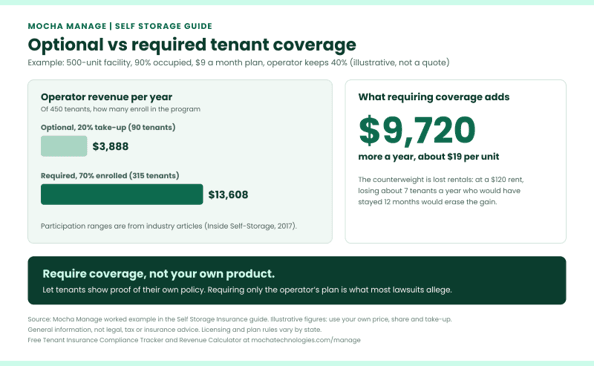
A 500-unit facility is 90% occupied, so 450 tenants. Assume the program charges $9 a month and the operator keeps 40%, or $3.60 per policy per month. These are illustrative figures, not a quote.
| Scenario | Tenants enrolled | Operator revenue per month | Per year |
|---|---|---|---|
| Optional program, 20% take-up | 90 | $324 | $3,888 |
| Required program, 70% enrolled | 315 | $1,134 | $13,608 |
| Difference | 225 | $810 | $9,720 |
A required program adds $9,720 a year in this example, about $19 more per unit per year. The $13,608 total is just under the roughly $14,000 to $30,000 a year that Inside Self-Storage (2017) cites for a well-run 500-unit program, so the example is conservative. The counterweight is lost rentals: if the average rent is $120 a month ($1,440 a year), losing about 7 tenants a year who would otherwise have stayed 12 months would erase the gain. StoragePug makes the same point, warning that losing one or two rentals a month can outweigh the extra plan revenue. If conversions fall at the insurance step online, make coverage proof a lease condition rather than a separate checkout hurdle, or test the requirement on one facility first. Track your own take-up and move-in conversion before and after any change.
An insurance requirement fails when proof of coverage lives in paper files. Mocha Manage is property management software for self storage, rental and community association operators, built to keep tenant records, leases, billing and communication in one place. That can give your team one place to record who has provided proof and who has not. Book a demo of Mocha Manage to see how it fits your facilities.
This article is for general information and is not legal, tax or insurance advice. Licensing, protection plan rules and lease enforceability vary by state. Have an attorney and your insurance advisor review your program, lease language and tenant notices before you use them.
Should self storage operators require tenant insurance? Many large operators do. Requiring proof of coverage, or enrollment in a plan, as a lease condition raises participation and sets expectations before a loss. The trade-off is possible friction at rental, so allow tenants to use their own policy and test the effect on conversions.
What is the difference between tenant insurance and a tenant protection plan? Tenant insurance is a policy from a regulated insurance carrier. A tenant protection plan is a contract with the operator, who accepts limited responsibility for loss up to a stated amount. Their regulation, risk and revenue differ.
Do I need a license to sell tenant insurance at my facility? Generally yes. Insurance sales are regulated, and many states offer a limited lines license for storage operators with training and disclosure requirements. Protection plans may not need one in some states, but rules vary, so confirm with your state association or an attorney.
Can a tenant use their homeowners or renters insurance? Often yes, if the policy covers goods in off-premises storage. Those limits are frequently lower than in-home limits and deductibles can be $500 or more, so ask for proof of the specific coverage.
How much coverage should I require? There is no standard. Many programs set minimum amounts by unit size, and tenant policy examples run from about $1,000 to $20,000. Choose tiers with your provider and counsel, and let tenants declare higher values.
What if a tenant has no proof of coverage? Follow the process in your lease: a written notice, a deadline, then enrollment in your program or another remedy if your state and lease allow it. Document everything, including coverage a tenant declines.
Disclosure: Mocha Manage publishes this blog. This guide is for informational purposes only and does not constitute legal advice. Consult a professional familiar with landlord-tenant law for advice specific to your situation.


