








All Mocha Apps
Back to Mocha Technologies
All Mocha apps

 Business OperationsManage day-to-day operations
 Property AccountingComplete property accounting
 Lease ManagementManage leases efficiently
- Pricing
All Mocha apps
Business OperationsManage day-to-day operationsProperty AccountingComplete property accountingLease ManagementManage leases efficiently
Key Takeaways
An HOA reserve study tells the board of a homeowners or condo association what its shared components will cost to repair or replace and how much to set aside each year to pay for them. Boards that skip it tend to face special assessments or loans when the roof, paving or elevators wear out.
This guide is written for HOA board members and community association managers. It explains what an HOA reserve study contains, how the main funding approaches differ, where special assessments fit, and how a community manager can help the board put the plan into practice. It is general information, not legal, tax or engineering advice. Some states set their own reserve requirements, so confirm what applies to your association.
Free Download: HOA Reserve Study Calculator and Prep Checklist (Excel). Enter your reserve balance, fully funded balance and assessment income. It returns percent funded, the health zone, the Fannie Mae 15% test, and the gap to close. It also includes a component schedule that calculates the fully funded balance and a 13-step study prep checklist. Download the free HOA Reserve Study Calculator and Prep Checklist (Excel)
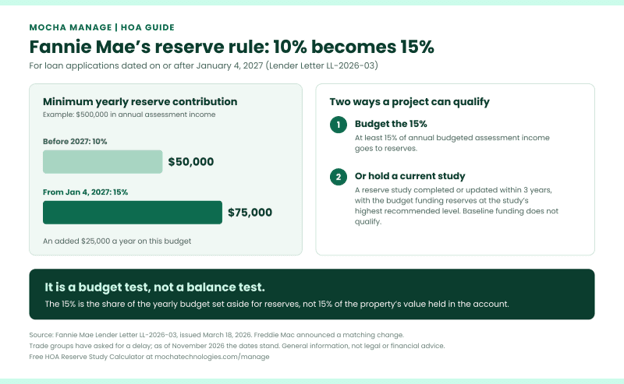
If your association funds below 15% and has no recent study, buyers in your community may find it harder to get a conventional mortgage. That is a resale and property-value issue, which is why boards should treat it as a budget decision, not a paperwork task.
Common areas wear out on a predictable schedule, but the bills arrive in large, uneven chunks. A reserve plan spreads those costs across years and across owners who actually use the assets, instead of leaving a future board with a shortfall.
A reserve study is a long-term planning report that identifies the components the association must maintain or replace, estimates how long each will last and what it will cost, and recommends a funding plan. Most reports have three parts.
For an HOA, percent funded is the current reserve fund balance divided by the fully funded balance. For example, an association with $300,000 in reserves and a fully funded balance of $600,000 is 50% funded. Industry guidance commonly treats 70% or higher as healthy, and associations below roughly 30% are more likely to need special assessments or loans. Read the number as a trend over several years, not a one-time grade.
Types and timing. A full study includes a site inspection and is often repeated every five to ten years, with updates every two to three years. Some states set their own rules, so check yours. For lending, Fannie Mae looks for a study completed or updated within three years.
Every reserve plan aims at a funding goal. The three standard goals trade off monthly cost against risk.
| Funding goal | What it does | Trade-off |
|---|---|---|
| Baseline | Keeps the reserve cash balance just above zero | Lowest contributions, highest risk if costs run high or projects come early |
| Threshold | Keeps reserves above a dollar amount or percent funded the board chooses | Balanced; only as strong as the chosen floor |
| Full funding | Keeps reserves at or near 100% funded | Highest contributions, lowest risk of special assessments |
An HOA special assessment is an extra charge to owners, approved under the governing documents, to cover costs the reserves cannot. Boards use them when a project is larger or earlier than planned. Industry data shows special assessments are common among associations funded under about 30%, less common between 30% and 70%, and rare above 70%.
Boards also compare two calculation approaches. The component method adds up each item's replacement cost and life, and the cash flow method projects contributions year by year to keep the balance from going negative.
Some lenders and states look at reserve levels too. For example, Florida has its own structural reserve study rules for condominiums, and Fannie Mae's guidance has asked for a reserve contribution of at least 10% of the budget, rising to 15% for loan applications dated on or after January 4, 2027 (see below). Confirm which rules affect your community.
A board can check where it stands in four questions:
1. Is the reserve share of the annual budget at least 15%? If yes, you meet the flat test.
2. If not, is there a reserve study completed or updated within the last three years?
3. Does the adopted budget fund reserves at the study's highest recommended level, not a lower alternative?
4. Does the study use a method other than baseline funding?
Answer "no" to question 1 and any of the next three, and the association should expect lender questions. The download includes a calculator that runs this test with your own numbers.
A full reserve study commonly runs about $1,500 to $25,000 or more, depending on the size and complexity of the community. Updates cost less:
| Study type | Typical cost | When to use it |
|---|---|---|
| Full study with site visit | About $1,500 to $25,000 or more | First study, major changes in components or maintenance duties, or when the last full study is stale |
| Update with site visit | About 50% to 70% of a full study | Roughly every three years, or when risk is higher |
| Update without site visit | About 30% to 50% of a full study | Annual or interim refresh when conditions have not changed much |
Price depends on the number and type of components, building age, amenities such as pools and elevators, and whether state law requires a licensed engineer.
| Percent funded | Zone | What it usually means |
|---|---|---|
| 70% or more | Healthy | Reserves cover most expected near-term work |
| 30% to 69% | Watch zone | Rising risk of larger contributions or a special assessment |
| Below 30% | Higher risk | Greater exposure to special assessments, loans, sharp increases and delayed projects |
Percent funded is a snapshot. Read the cash-flow projection next to it. An association at 60% with a steady contribution can be safer than one at 75% with a major replacement due next year.
There is no single national requirement, so a board has to check its own state. A few examples:
| State | What the sources say |
|---|---|
| California | Generally requires a reserve study inspection every three years with an annual review |
| Florida | Certain condominium buildings of three habitable stories or more need a Structural Integrity Reserve Study (SIRS), generally every 10 years |
| Nevada | Operates on a five-year study cycle, longer than Fannie Mae's three-year lookback |
| Utah | Requires studies on a five-to-six-year cycle, also longer than the three-year lookback |
| South Carolina | No reserve study mandate or minimum funding requirement, according to an industry group |
The Nevada and Utah rows matter for lending. A fully state-compliant association can still have a study that is too old for Fannie Mae's three-year window. Confirm requirements with association counsel.
These are illustrative planning ranges, not estimates for any community. Your study will replace them with figures for your buildings.
| Component | Typical useful life (years) |
|---|---|
| Roofing systems | 20 to 30 |
| Boilers | About 15 to 25 |
| Asphalt resurfacing | About 8 to 15 |
| Pool plaster | About 8 to 12 |
| Exterior painting | About 5 to 10 |
| Year | Action | Output |
|---|---|---|
| 1 | Commission a full study, verify the component list and reconcile reserve cash | Final study, baseline percent funded, first capital calendar |
| 2 | Board reviews findings and adopts the funding plan | Approved contribution, updated budget, owner summary |
| 3 | Reserve update or site review; begin required major repairs | Updated assumptions, revised contribution plan |
| 4 | Mid-cycle review for inflation, actual costs and failures | Variance report, revised sequencing |
| 5 | New full study where warranted, or a site-visit update | Updated long-range plan and next-cycle schedule |
The board makes the decisions, and the manager keeps the process moving. A good manager supports reserve planning in five practical ways.
1. Keeping the schedule. Track when the last full study and updates were done, and put the next one on the board's calendar before it is overdue.
2. Gathering the inputs. Collect component records, warranties, contractor invoices, past replacements and photos so the reserve analyst has accurate data.
3. Choosing a qualified provider. Help the board request proposals from reserve study professionals with recognized credentials, such as accreditation through the Community Associations Institute or the Association of Professional Reserve Analysts, and compare scope and price.
4. Turning the report into a budget. Walk the board through the funding options, show the effect on each owner's assessment, and prepare the budget so the reserve contribution is clear.
5. Communicating with owners. Explain why reserve contributions exist, share summaries in plain language, and present the plan at the annual meeting. Owners tend to see reserves as a cost until they understand they are a financial protection.
Throughout the year, managers also track reserve balances, record reserve spending against the right components, and flag when a project is approaching sooner or costing more than the study assumed. Boards should review those figures regularly, not just at budget time.
##Download the free HOA Reserve Study Calculator and Prep Checklist (Excel)
The Excel workbook has three tabs:
Download the HOA Reserve Study Calculator (.xlsx)
A reserve plan only works if the money is tracked and spent against it. Mocha Manage gives HOA and COA managers and boards one place for assessments, budgets, accounting records and work orders, so reserve contributions, project spending and owner communication stay connected. That makes it easier to show the board where reserves stand and to prepare for the next study.
Book a demo of Mocha Manage to see how community managers support boards.
How often should an HOA have a reserve study? A full study is often repeated every five to ten years, with updates every two to three years. Some states set their own schedule, and Fannie Mae looks for a study completed or updated within three years.
How much should an HOA have in its reserve fund? There is no single number. Boards look at percent funded, with 70% or higher commonly treated as healthy, and at whether the funding plan keeps pace with component wear.
What happens if the reserve fund is too low? The association may need a special assessment, a loan or a sharp assessment increase when a major component fails. A reserve funding plan spreads those costs over time instead.
How does Fannie Mae's 15% rule affect our HOA? For loan applications dated on or after January 4, 2027, a condo project generally needs at least 15% of annual budgeted assessment income going to reserves, or a study completed or updated within three years and a budget that funds the study's highest recommended level. Talk to your manager, reserve study provider and counsel about your numbers.
What does a reserve study cost? A full study commonly runs about $1,500 to $25,000 or more. Site-visit updates are about 50% to 70% of a full study, and updates without a site visit about 30% to 50%.
What is a healthy percent funded? 70% or more is generally considered healthy, 30% to 69% is a watch zone, and below 30% signals higher risk. Review the cash-flow projection alongside the number.
This article is for general information and is not legal, tax or engineering advice. Reserve requirements vary by state, and your association's governing documents control.
Disclosure: Mocha Manage publishes this blog. This guide is for informational purposes only and does not constitute legal advice. Consult a professional familiar with landlord-tenant law for advice specific to your situation.


